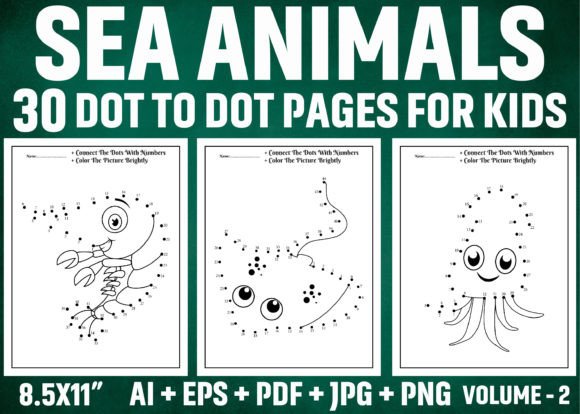
Sea Animals Dot to Dot Pages for Kids: A Practical Guide to Choosing and Using Premium Activity Interiors
Whether you are an educator assembling a resource library, a parent looking for a screen-free activity that actually holds attention, or a small business owner navigating the Kindle Direct Publishing landscape, the humble dot-to-dot page holds surprising potential. Connecting numbered points to reveal a sea turtle or a giant whale is a timeless educational exercise. However, creating or buying a collection like the Sea Animals Dot to Dot Pages for Kids (and its Volume 2 companion) involves more than just finding a cute PDF. The difference between a resource that delights children and one that ends up in the recycling bin often comes down to overlooked technical details and design choices. This guide focuses on the practical decisions that separate a high-quality activity book from a disappointing one.
Overlooking the Developmental Value of Structured Sequencing
A common mistake is treating dot-to-dot activities purely as a way to keep kids quiet. While they are certainly effective for that, their real value lies in reinforcing numerical sequencing, fine motor control, and hand-eye coordination. A poorly designed page—with cluttered numbers or lines that cross important visual elements—can undermine these benefits and frustrate a young learner.
When evaluating a package like the Sea Animals Dot to Dot Pages for Kids, look for the logic behind the numbering. The "Victor Illustration" style noted in the product details suggests a focus on clean, child-friendly aesthetics. You want numbers that are large enough to read without squinting, yet subtle enough not to distort the final image when the dots are connected. Volume 2, with its larger collection of pages, allows for gradual progression in complexity, which is excellent for sustained skill building over weeks or months of use.
The Technical Traps: Why DPI and Format Make or Break Your Project
This is perhaps the most expensive mistake you can make, especially if you are publishing on KDP. Uploading an interior that looks sharp on your screen but prints poorly is a fast track to negative reviews and refund requests. The product specification clearly states 300 DPI files in JPG and PNG formats. This is non-negotiable for professional print quality. Lower resolution images will appear pixelated and unprofessional on paper, instantly devaluing your book in the eyes of the buyer.
Furthermore, the inclusion of multiple formats—AI, EPS, PDF, JPG, and PNG—speaks to a flexible workflow. Many beginners make the error of buying a single PDF and hoping it works universally. With this bundle, you have vector files (AI and EPS) which are crucial if you need to resize elements without losing quality, or if you want to tweak the interior layout for a slightly different trim size. For KDP, the PDF file is your direct upload path, but having the JPG and PNG files is invaluable for creating marketing mockups or previews for your Amazon listing. Always verify that the files match the stated 8.5" x 11" trim size perfectly, including any required bleed for print.
User Experience Pitfalls in Activity Book Interiors
Have you ever bought a dot-to-dot book where the numbers are impossibly small, or the dots are so close together that the line looks like a scribble? These are signs of an interior designed by someone who never actually used it with a child. A premium interior accounts for the user's physical experience with a crayon or pencil.
The Sea Animals Dot to Dot Page for Kids volumes address this by offering 30 Victor Illustration dot-to-dot pages within a 64-page total count. This leaves room for test pages or a certificate of completion. When evaluating such a product, ask yourself: Are the illustrations engaging without being overly complex? Is there enough contrast between the dots and the background? Will the final revealed image look rewarding enough to color in? The "sea animals" theme inherently offers variety, from clownfish to dolphins, which keeps the activity fresh across multiple sessions.
Another overlooked detail is paper bleed. While the interior file is black and white, the type of paper you print on or the KDP trim you choose matters. Thicker paper is better for markers or crayons, but adds cost. Knowing that your file is clean and optimized helps you manage these production variables without surprises.
Format Fluency: Getting the Most from Your AI, EPS, PDF, JPG, and PNG Assets
Receiving a .zip file packed with different formats can feel overwhelming for a beginner, but it is actually a sign of a professional-grade product. The mistake many make is using only the PDF and ignoring the vector files completely. If you know your way around Adobe Illustrator or CorelDRAW, the AI and EPS files are gold.
- Customize the cover: Match the interior style perfectly for a cohesive brand look.
- Adjust page elements: Move a number slightly if it clashes with a major drawing detail.
- Create new derivatives: Build a completely new activity book using the high-quality vectors as a base for future projects.
For those focused purely on publishing, the ready-to-upload PDF file streamlines the KDP process. The PNG and JPG files (at 300 DPI) are perfect for creating promotional materials, social media posts to showcase "sneak peeks" of your book, or even printing single pages for classroom sampling. Ignoring these assets means leaving significant value on the table.
Strategic Positioning on KDP: Selling the Experience, Not Just Pages
The difference between a book that sells and one that languishes often comes down to positioning. Simply listing "Dot to Dot" in your title is not enough. The best-selling KDP interiors bundle the activity with a broader educational or entertainment promise.
Volume 1 and Volume 2 of the Sea Animals Dot to Dot Pages for Kids represent a clear opportunity to create a series. Savvy publishers use the first volume to build an audience and the second to satisfy repeat customers who want more. When you list your book, emphasize the "100 high-resolution pages" or the "30 unique illustrations." Parents and teachers are specifically searching for substantial content that offers hours of engagement, not just a thin booklet.
Keywords matter significantly. Think beyond "dot to dot." Include variations like "sea animal activity book," "ocean dot to dot for kids," "preschool counting workbook," and "KDP interior ocean animals." The more specific you are, the better you can target niche audiences. Avoid the common mistake of using overly generic keywords that have insane competition. A well-crafted listing with strong A+ content, built using those high-res JPGs, will convert browsers into buyers much more effectively.
Staying Within Platform Guidelines for Long-Term Success
A critical, non-negotiable point is understanding the license agreement. The product description explicitly states, "You can sell it only on Amazon Kindle Direct Publishing." This is a common point of confusion for small business owners who are used to selling on multiple platforms like Etsy or Teachers Pay Teachers. Using this specific interior on those platforms would violate the terms of use and could result in account suspension or legal action.
Respecting these boundaries protects your business. If you need a multi-platform license, you must purchase a product explicitly offering that flexibility. For this specific bundle, the focus is squarely on KDP success. This means you can confidently use it to build your low-content book business on Amazon without worrying about copyright infringement or platform policy violations. This clarity is actually a benefit, as it simplifies your decision-making process.
Creating a successful activity book, whether for personal classroom use or commercial publication, is a blend of art and technical precision. By paying close attention to the resolution, file formats, user experience, and strategic positioning of products like the Sea Animals Dot to Dot Pages for Kids Volume 1 & 2, you set yourself up for a smoother workflow and a better final product. Avoid the common pitfalls of low resolution, generic marketing, and neglecting the developmental value. Focus on quality, and the results will follow naturally.